
Horse Boots
(398)A horse’s legs are extremely slender and delicate in comparison with its body. This creates an increased risk of injury. During training, romping about... LEARN MORE








Frequently asked questions about Horse Boots
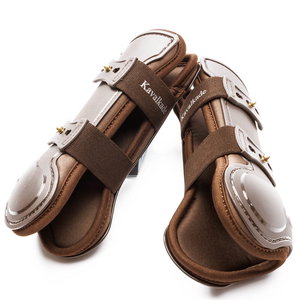
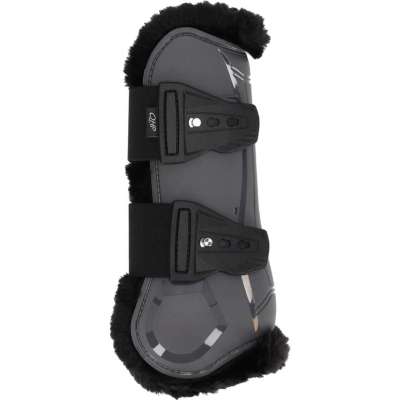
Horse boots are used to protect the horse's sensitive legs from injuries that can occur due to external influences or when the legs are knocked together. Especially for show jumping and eventing, horse boots are an important piece of equipment, as the risk of the horse hitting poles, branches or tree trunks is high. In dressage or when training young horses, it often happens that the animals kick themselves. In this case, horse boots also prevent damage to the tendons and joints.
It is important to put the horse boots on the horse's leg correctly so that they do not slip and there are no pressure or chafing points. Put the horse boots on the back of the leg at the level of the carpal joint and pull them down until they end at the fetlock joint. This way you can make sure that the hair is smoothly swept down and not crosswise. Then you can close the horse boots. The closure must always be on the outside and face backwards. The brushing boots should be tight enough that they cannot slip, but not so tight that the lymph and blood flow is disturbed.
For each discipline, there are certain horse boots that have the corresponding properties and thus ensure optimal protection. If you are riding a lot in cross-country or eventing, you should fall back on air-permeable, but closed horse boots with a hard outer shell, since the horse's legs should mainly be protected from external influences. These models have the advantage that your horse does not sweat too much under them during longer distances and that the tendons do not become over-sensitive due to the heat.
In dressage, special dressage boots with or without fur have proven themselves, which protect the horse from its own kicks. In addition, they can also be ideally combined with the rest of the riding outfit.
Horse boots for show jumping usually consist of a hard outer shell and special reinforcements, so that the sensitive horse leg is protected from injuries in the best possible way in the course. Here, too, you can choose between variants with or without lambskin.
The choice of horse boots for your horse depends on various factors, including which discipline you ride and on how sensitive your horse is. Whether you choose hard shell boots with fur or prefer fetlock boots for your four-legged friend is ultimately up to you. They all protect the horse's leg from external influences and prevent injuries. It is best to test several models and then decide which one your horse feels most comfortable with.
Horse boots: sophisticated, refined, functional
In general, there are horse boots specially designed for each discipline, for both ponies and horses. Horse boots differ depending on the discipline and, oftentimes, in their material composition and style. This is why manufacturers seek to ensure that horse riding boots are coordinated to the challenges they can be anticipated to face. Because for horses, comfort is just as important as the effective protection that is provided to the horse’s sensitive extremities.
Horse boots are similar to cuffs and can be wrapped tightly around the horse's leg. Moreover, some designs are available as anatomically formed hard-shell horse riding boots. Thanks to the consistent quality of both versions, your horse's legs are well supported under heavier load.
In disciplines such as dressage, eventing and show jumping, horse boots prevent overstretching of the horse’s ankles, tendons, and so on. Snapping and stumbling risks are thereby likewise reduced.
The effects of blows, scratches or legs knocking together are effectively reduced. Whether it is a night in the stable, a collision with an obstacle or a ride through the meadows and woods - horse boots counter danger at the source.
Materials: from natural to high-tech
Tradition and innovation literally meet where horse boots are concerned. Because these important protectors are constantly being developed in order to provide the best possible protection for the more sensitive parts of your horse’s body.
The materials processed in the manufacture of horse boots for horses range from unadulterated to high-tech products. Oftentimes, the materials are even combined on account of their properties.
Among the most used materials are leather, imitation leather, TPU, neoprene, EVA foam, fleece and polyester mesh fabric. Carbon reinforcements are often included in the offer. Horse riding boots are available in white, black, brown, or bright colours. In addition, some designs focus on fashionable highlights, such as patterns, applications or glittering, sparkling surfaces.
Benefits of hoof boots attributable to material composition:
- durable
- sturdy
- breathable
- protective
- supportive
- easy to clean and durable
- shock-absorbing
Putting horse boots on properly
A decisive advantage is that even inexperienced riders can put on a pair of horse boots. They have a more solid form, which makes it practically impossible to put the leg protectors on wrong or too tight. The decisive issue is whether the horse boots fit the horse's legs. In our Online Shop, you will find information on sizes in the various product descriptions.
Sinc